
North is a direction.
The star is temporary.
01
Before Polaris
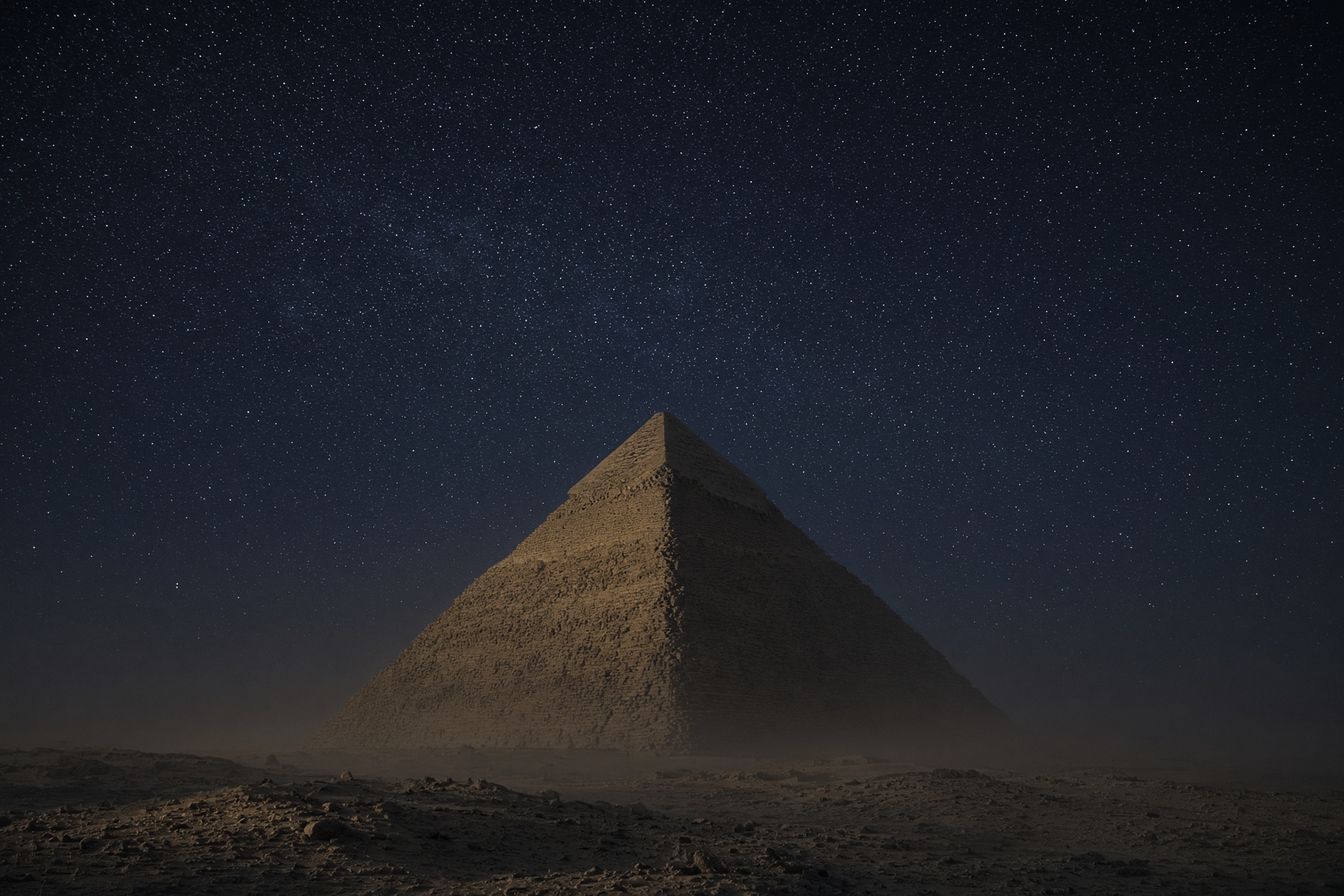
Around 2700 BCE, Thuban in Draco held the northern office. It had been the closest naked-eye star to the pole for a long time already. Published accounts put its closest approach near 2830 BCE, under 10 arcminutes from the north celestial pole.1
On the plateau at Giza, a builder still had to set one edge toward north. The sky offered more than one way to do it.
The Great Pyramid is aligned to the cardinal directions with a precision that still startles. How that north was found remains a research question. A 1964 study proposed that a northern shaft pointed toward Thuban. In 2000, Kate Spence argued in Nature that the builders could have watched Kochab and Mizar cross the meridian together. The stones remember a direction. They do not, by themselves, name the star.2
The title was not passed hand to hand
Thuban did not give the office directly to Polaris. After Thuban, the pole moved through a dimmer stretch of Draco. Kappa Draconis, fainter than the stars we like to put on posters, became the nearest naked-eye star. Kochab, in the bowl of the Little Dipper, then served as the important northern reference. With Pherkad it was later called one of the Guardians of the Pole.3
Even near its best, around 1100 BCE, Kochab remained on the order of 7° from the pole. Useful to a watcher. Nothing like the nearness we grant Polaris. There were long ages with no bright star close to north.
02
The Great Turning
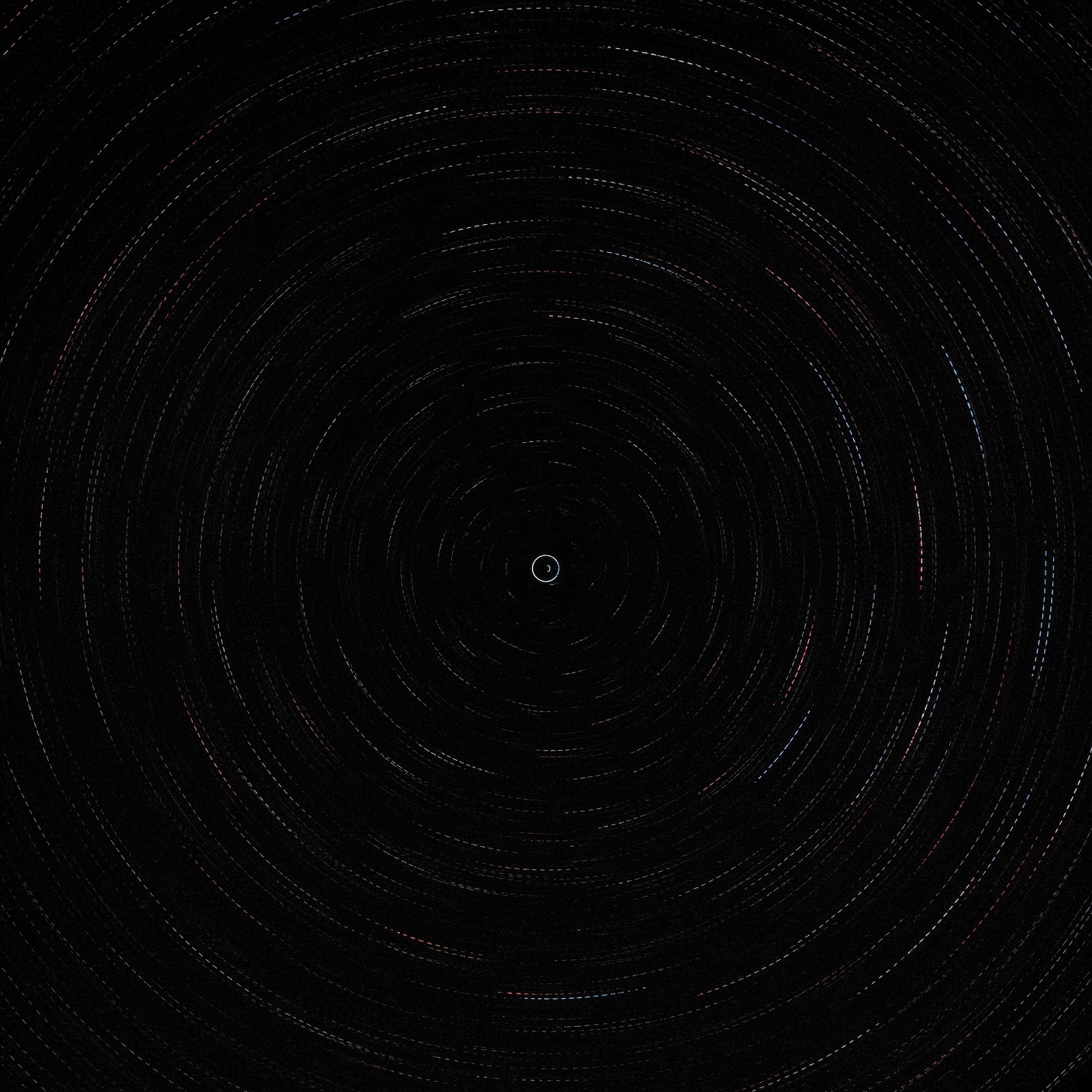
The night looks still. Earth’s axis is not locked to one star. It slowly changes direction. One full cycle takes about 25,800 years, often rounded to 26,000. Against the stars, the north celestial pole draws a circle whose radius is the tilt of the axis, about 23.4°.4
Model year 2026 CE. Nearest named star Polaris, 38′ (0.63°).
Gold is not the key. Ember ring, the north celestial pole. Ember star, the nearest name on this plate. Ice circle, the pole’s path. Red, blue, and white points are the named stars. Center is the north ecliptic pole.
2700 BCE
1100 BCE
1599
2010
Now
2100
Far from now
03
The Almost-Stationary Star
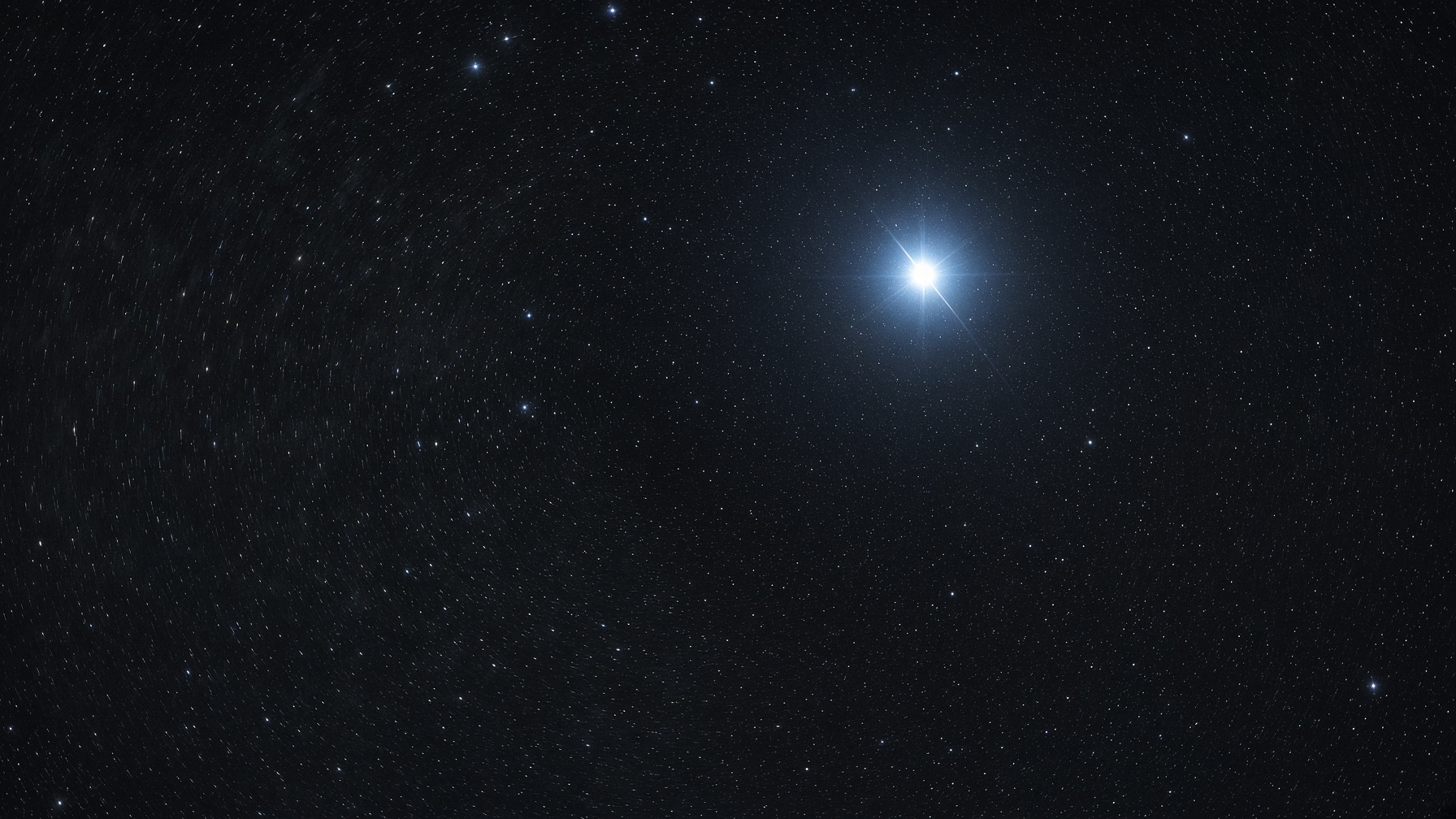
Its altitude above the horizon is nearly your latitude. Overhead at the north pole, it sinks toward the sea as you travel south. In the course of a sidereal day it still draws a small circle, so its bearing is true north only twice a day. The rest of the night a careful navigator applies a correction. The tables in the nautical almanacs, and in Bowditch’s American Practical Navigator, exist because the guide is almost true.5
In 2018 Polaris stood 0.66° from the pole of rotation, 39.6 arcminutes, and the little circle was about 1.3° across.6
Epoch 2010.041′35″
Jean Meeus computed that separation for epoch 2010.0: declination +89°18′25″, which is 41′35″ from the pole, about 0.7°. Round the minutes and the figure becomes 42. It is already historical. The gap has kept closing.7
Meeus also places the closest approach early in the twenty-second century, a little under half a degree. One report of that work gives 24 March 2100 and 27′09″. Another gives February 2102 and 27′37″. The star approaches. It does not arrive.8
Forty-two arcminutes is a rounded measure of a passing distance. Almost north. Never quite the pole.

But I am constant as the northern star,
Of whose true-fix’d and resting quality
There is no fellow in the firmament.
Shakespeare writes the line around 1599 and gives it to Caesar in the Senate, in the scene where he is killed. The historical Caesar died in 44 BCE. The constancy belongs to the play, and to the sky of Shakespeare’s audience. On this page’s model, Polaris in 1599 still stood about 2.9° from the pole.9
04
After Polaris
The pole moves on. It passes nearer Errai, Gamma Cephei, around the year 4000. In this model that miss is still about 2°. Deneb, near the year 10000, remains several degrees off. Vega, much brighter than Polaris, is the star people will name. Published chronologies often place that passage near 14000 to 14500. In the model here, Vega’s closest approach is about 4.8°, near the end of the fourteenth millennium.10
Brighter. Looser. A traveler then will still need north, and Vega will not be the pin.
Thuban comes back to the office on the order of 20,000 years from now, and then leaves again.
What is measured, and what is drawn
- 2830 BCE
- Thuban under 10′ from the pole. Published summary, not this model.
- 1100 BCE
- Kochab on the order of 7° off. A reference, not a pin.
- 2010.0
- The published separation.
- 2018
- 39.6′. The gap was still closing.
- Near 2100
- About 27′. Two reports of Meeus differ by a year and a hair.
What does it mean to find our way
in a universe where even the star we follow
is temporary?
Notes
Polaris, in The Book of 42 stays a doorway.
- Wikipedia, “Thuban,” accessed 24 September 2026. Closest naked-eye star to the pole from 3942 BCE until 1793 BCE. Closest approach in 2830 BCE, under 10 arcminutes. Thuban.
- Virginia Trimble, “Astronomical Investigation concerning the so-called air-shafts of Cheops’ Pyramid,” Mitteilungen des Instituts für Orientforschung 10 (1964). Kate Spence, “Ancient Egyptian Chronology and the Astronomical Orientation of the Pyramids,” Nature 408 (16 November 2000): 320–324. Spence’s method is Kochab and Mizar crossing together, not a Thuban sightline.
- Wikipedia, “Kochab,” accessed 24 September 2026. Within roughly 7° of the pole by 1100 BCE. With Pherkad, a Guardian of the Pole. The sequence after Thuban is Kappa Draconis, then Kochab, not a direct handoff. Kochab.
- The usual modern round figure for axial precession is about 25,772 to 25,800 years. The instrument uses 50.290966 arcseconds a year and a fixed obliquity of 23.439°. It is a teaching model.
- Wikipedia, “Polaris,” accessed 24 September 2026. In 2018 the separation was 0.66°, 39.6 arcminutes, and the daily circle about 1.3° across. Polaris.
- Jean Meeus, Mathematical Astronomy Morsels (Richmond, Va.: Willmann-Bell, 1997), as reported in “Chasing the Pole,” accessed 24 September 2026. Epoch 2010.0, declination +89°18′25″, separation 41′35″. Chasing the Pole.
- EarthSky, reporting Meeus: 24 March 2100, 27′09″. “Chasing the Pole,” also reporting Meeus: February 2102, 27′37″. Both put the minimum a little under half a degree, soon after 2100.
- William Shakespeare, Julius Caesar, act 3, scene 1, written around 1599. Caesar speaks the line in the Senate and is killed in that same scene. The historical assassination is 15 March 44 BCE. The 2.9° figure is this page’s model for 1599, not a catalog place from the play’s year or from 44 BCE.
- Wikipedia, “Polaris,” accessed 24 September 2026: Errai around 4000, Deneb around 10000, Vega around 14500. The misses in the prose, about 2°, several degrees, and about 4.8°, belong to this page’s model, not to that article.
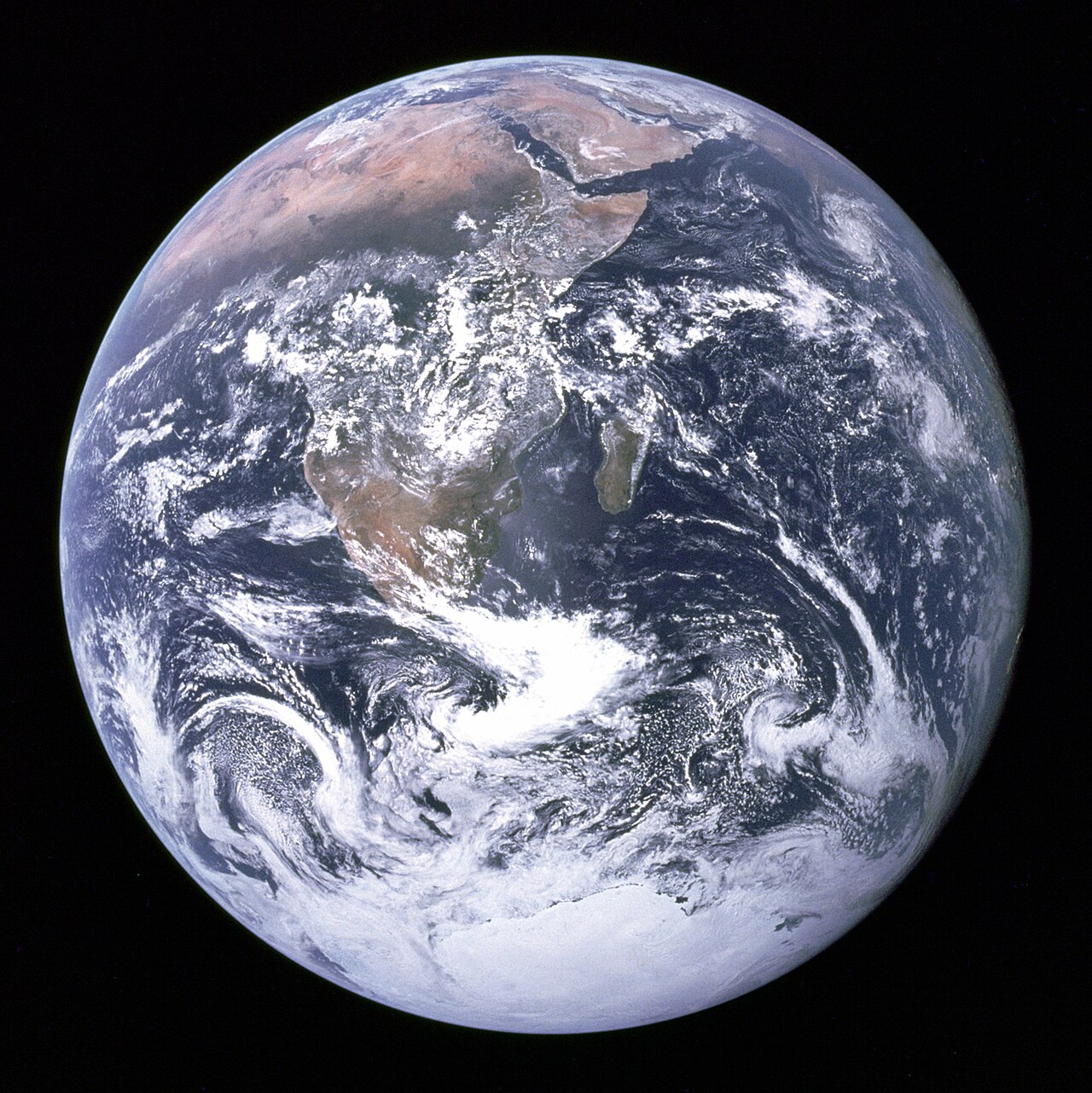
NASA, Apollo 17 photograph AS17-148-22727, 7 December 1972. Public domain. That picture is the Earth. The other frames on this page are drawings.